Listening to Spacetime
For a few tenths of a second in September 2015, two laser beams in Louisiana and Washington stretched and shrank in step. That coincidence was the first direct sound of two merging black holes.
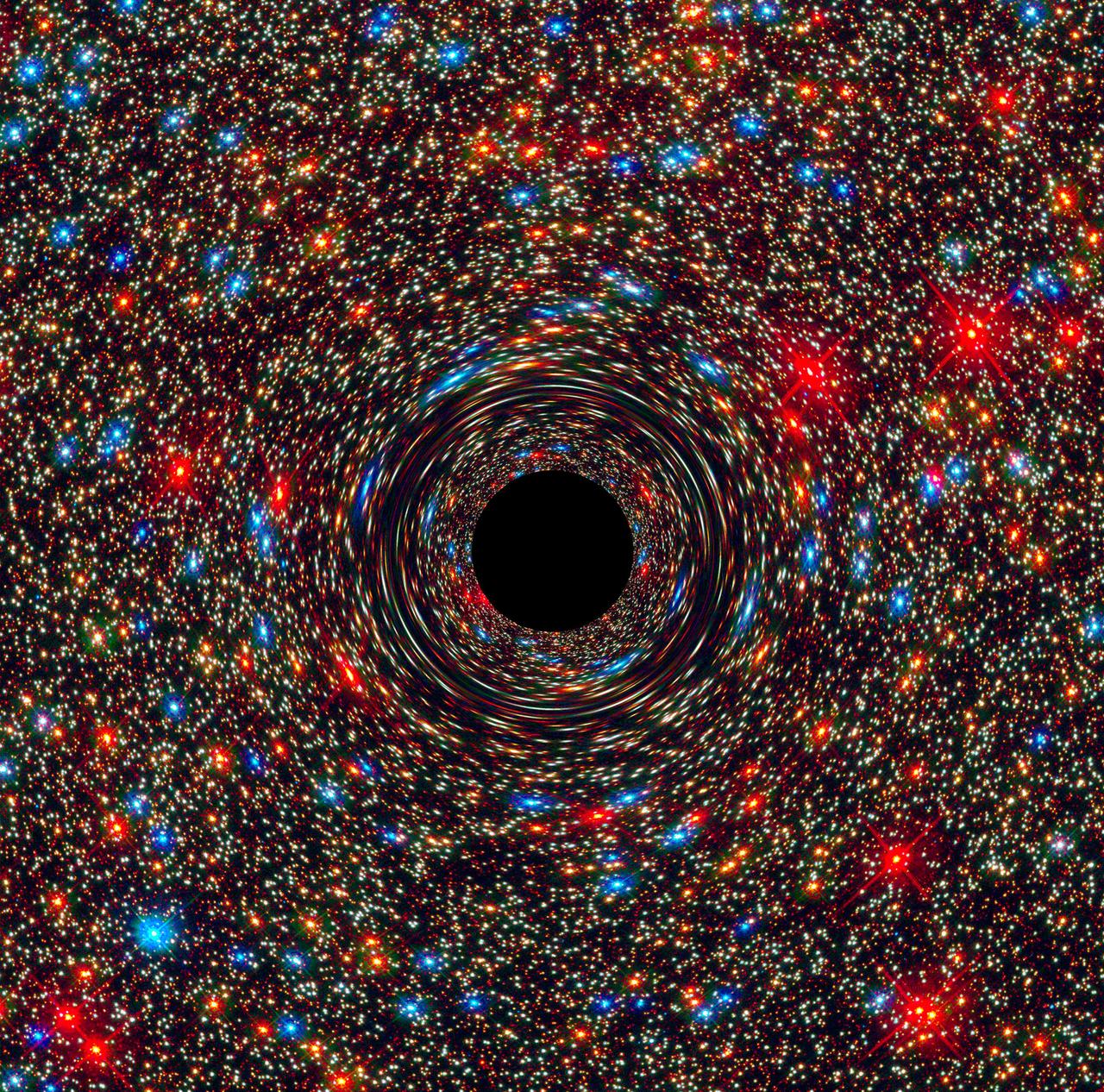
If space and time are a fabric that can bend, then that fabric should also be able to ripple. The idea is not new. Einstein's equations predicted gravitational waves within months of the theory's publication in 1915, and he spent the following years partly doubting his own result before agreeing it was real.1 For a century the prediction was formally correct and empirically silent: the waves were far too weak to detect.
Accelerate a mass with a changing quadrupole moment — think of two heavy objects orbiting each other — and the disturbance propagates outward at the speed of light. The wave stretches one direction while compressing the perpendicular direction, and the amplitude is tiny, typically a one-thousandth of a proton's width over the four-kilometre arms of a detector. Detecting that took the most sensitive measurement instruments ever built.
How LIGO hears
LIGO works on interference. A laser beam splits at the corner of an L-shaped vacuum tube, travels four kilometres down each arm, reflects off a mirrored test mass, and comes back. When the two beams recombine, their interference pattern reveals any difference in the travel times down the arms. A passing gravitational wave shifts the two arms differentially, and the interference fringes move accordingly.2
The engineering is a catalogue of exclusions: seismic isolation to reject tiny floor vibrations, vacuum quality good enough that almost no gas molecule remains in the beam path, mirror coatings with minimal thermal noise, and a worldwide network so that a single-detector glitch can be distinguished from a genuine, shared signal. Two detectors thousands of kilometres apart firing together is not a coincidence — it is the point.
What the first detection actually was
On 14 September 2015 the two Advanced LIGO detectors recorded the characteristic chirp of two black holes, roughly 36 and 29 solar masses, spiralling in and merging about 1.3 billion light-years away. The waveform sweeps upward in frequency as the pair circle faster, then stops as they merge — a signature no other source should mimic.3
Why it matters for more than gravity
Electromagnetic astronomy sees the universe through photons, and photons are stopped by dust, by plasma, by the surface of a star. Gravitational waves pass through all of it almost untouched. They open a genuinely different channel onto events that are otherwise invisible: black-hole collisions, neutron-star mergers, and the violent collisions that forge heavy elements such as gold.
The 2017 detection of two merging neutron stars — GW170817 — was the clearest demonstration. The gravitational-wave chirp was followed about two seconds later by a gamma-ray burst and, hours after that, by optical telescopes finding a new kilonova in the same patch of sky. For the first time, one event was heard and seen.4
- confirmed Gravitational waves exist, travel at the speed of light, and have been detected in dozens of events.
- confirmed Multi-messenger astronomy with waves and light has been demonstrated (GW170817).
- open What the same technique can reveal about the earliest universe or about the nature of dark matter remains an unfolding research frontier, not a settled result.
The larger lesson is about how physics actually advances. A prediction from 1916 sat untested for a hundred years not because it was contested but because it was unfalsifiable in practice. When the instruments finally caught up, the theory was confirmed in a single afternoon of engineering work that took decades.
Further reading (external sources)
- Einstein, A., “Näherungsweise Integration der Feldgleichungen der Gravitation” (1916), Sitzungsberichte der Königlich Preußischen Akademie der Wissenschaften.
- LIGO Scientific Collaboration and Virgo Collaboration, “Observation of Gravitational Waves from a Binary Black Hole Merger”, Phys. Rev. Lett. 116, 061102 (2016) — doi:10.1103/PhysRevLett.116.061102.
- Nobel Prize in Physics 2017, “Observation of gravitational waves” — nobelprize.org.
- LIGO/Virgo, “Multi-messenger Observations of a Binary Neutron Star Merger” (GW170817), ApJL 848, L12 (2017) — doi:10.3847/2041-8213/aa91c9.
This article is an original explanatory text written for The Open System; it is not a translation or a reproduction of any source above. Sources are listed for verification and further reading. Image: NASA (public domain).