The Universe Has No Edges
Galaxies are not flying away from a point in space. Space itself is stretching between them — and that distinction changes what “the edge of the universe” could possibly mean.
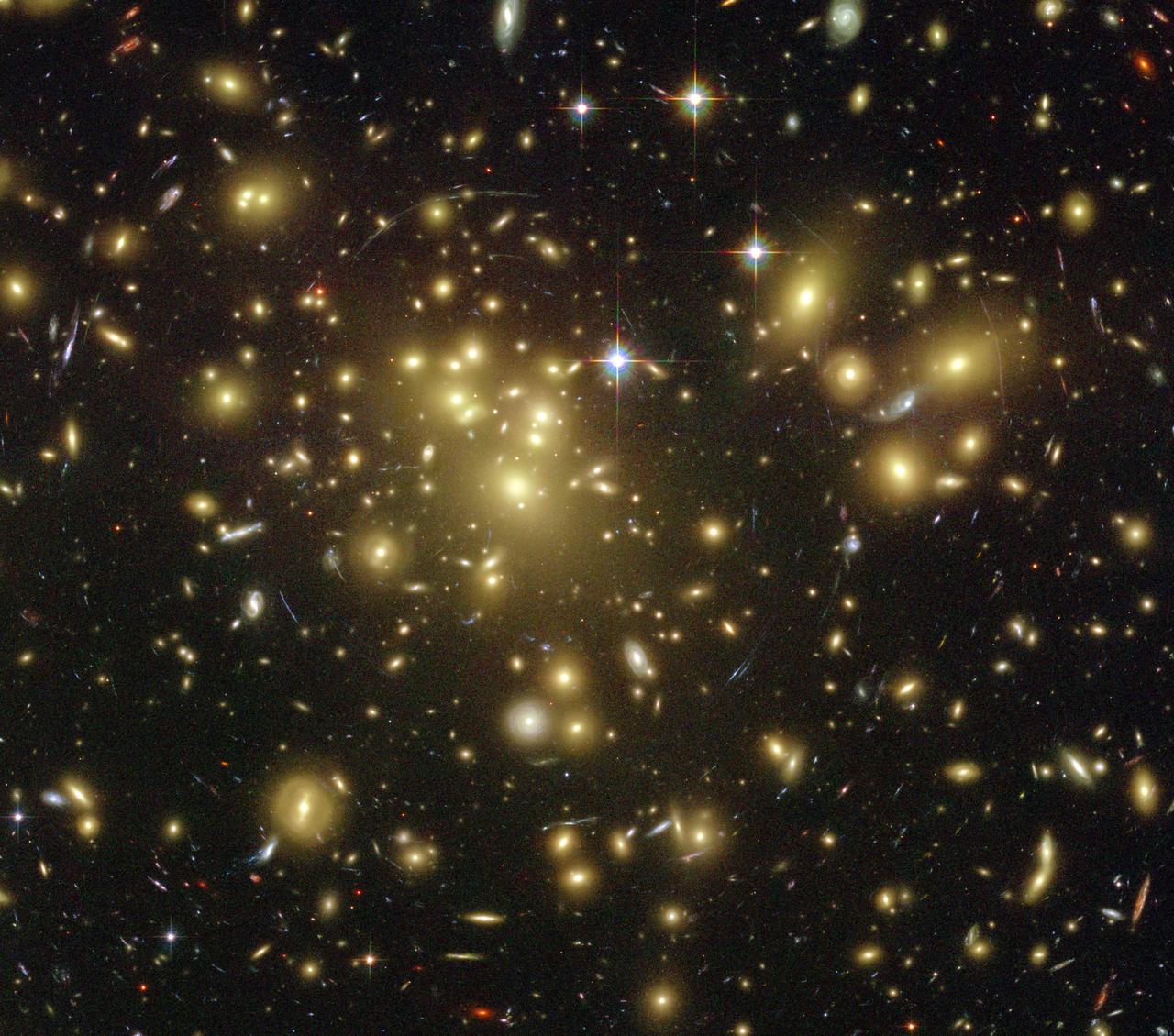
Start with the observation that made expansion unavoidable. Light from distant galaxies is redshifted — its spectral lines are shifted toward longer wavelengths — and the shift grows with distance. If that shift came from ordinary motion, it would mean everything is streaming away from us, which would put us at the centre of a bang. The accepted interpretation is different and far less flattering: the space between us and those galaxies has been expanding while the light was in transit, stretching the photons along with it.1
This is why the “exploding firework” picture misleads. In a firework, fragments move through space away from a point. In cosmology, there is no distinguished point and no outside: the metric itself grows. Two distant galaxy clusters are further apart today than yesterday because the interval between them increased, not because they pushed through anything.
The common objection, answered
“If everything is expanding, why aren't the Solar System and my desk expanding too?” Because expansion is a description of an average, on the largest scales, where matter is treated as smoothly distributed. In regions where matter has clumped into bound structures — galaxies, clusters, you, the desk — the local gravitational binding overwhelms the cosmological stretching. A bound system does not expand; its inner dynamics simply govern. The expansion applies to the large-scale geometry, not to every object inside it.
The same logic removes the centre. Every observer anywhere in a homogeneous universe sees the same pattern: distant galaxies receding with redshift proportional to distance. That is not a coincidence — it is what a homogeneous and isotropic expansion looks like from any vantage point.
What “the edge” would even mean
Observable-universe boundaries are not physical walls. They are the limits of what light could have reached us since the beginning. As time passes, the observable patch grows; the universe itself is not acquiring new material at a boundary.
What the evidence actually is
Expansion rests on several independent lines of evidence, which is why it is accepted so widely.2
- confirmed Hubble's law: recession redshift proportional to distance, measured with distance ladders including Cepheid variables and type Ia supernovae.
- confirmed Time dilation of distant supernova light curves, an effect that follows directly from stretching space.
- confirmed The cosmic microwave background, whose temperature and acoustic peaks fit an expanding universe precisely.
- confirmed Primordial abundances of light elements, which match predictions of a hot early universe.
Where the numbers are argued about
The expansion rate itself — the Hubble constant — is measured in two main ways. Local distance-ladder measurements tend to give a value around 73 km/s/Mpc; inferences from the early-universe cosmic microwave background, within the standard model, tend to give about 67–68 km/s/Mpc. The discrepancy, if it is not an unrecognised systematic effect, would be a genuine crack in the standard cosmological model. Careful reviews of the measurements have not yet resolved it either way.3
- open The Hubble tension between local and early-universe determinations is unresolved.
- open What drives accelerated expansion (dark energy) is unknown.
- speculative Novel solutions that alter gravity or introduce new fields are proposed, but none is confirmed.
That is the honest state of the art: the expansion is real and extremely well evidenced; the rate is measured precisely twice and disagrees; the thing accelerating it has no agreed identity. Those are the open questions worth following, and they are not the ones usually found in headlines.
Further reading (external sources)
- Harrison, E. R., “Hubble's Law”, in Cosmology: The Science of the Universe — overview of the observational basis.
- Planck Collaboration, “Planck 2018 results VI: Cosmological parameters” — doi:10.1051/0004-6361/201833910.
- Verde, L., Treu, T., Riess, A. G., “Tensions between the early and late Universe”, Nature Astronomy 3, 891 (2019) — doi:10.1038/s41550-019-0902-0.
This article is an original explanatory text written for The Open System; it is not a translation or a reproduction of any source above. Sources are listed for verification and further reading. Image: NASA/ESA (public domain).