The Oldest Light in the Universe
When the universe cooled enough to become transparent, light was set loose. It has been travelling ever since, stretched into microwaves — and it still carries a picture of the young cosmos.
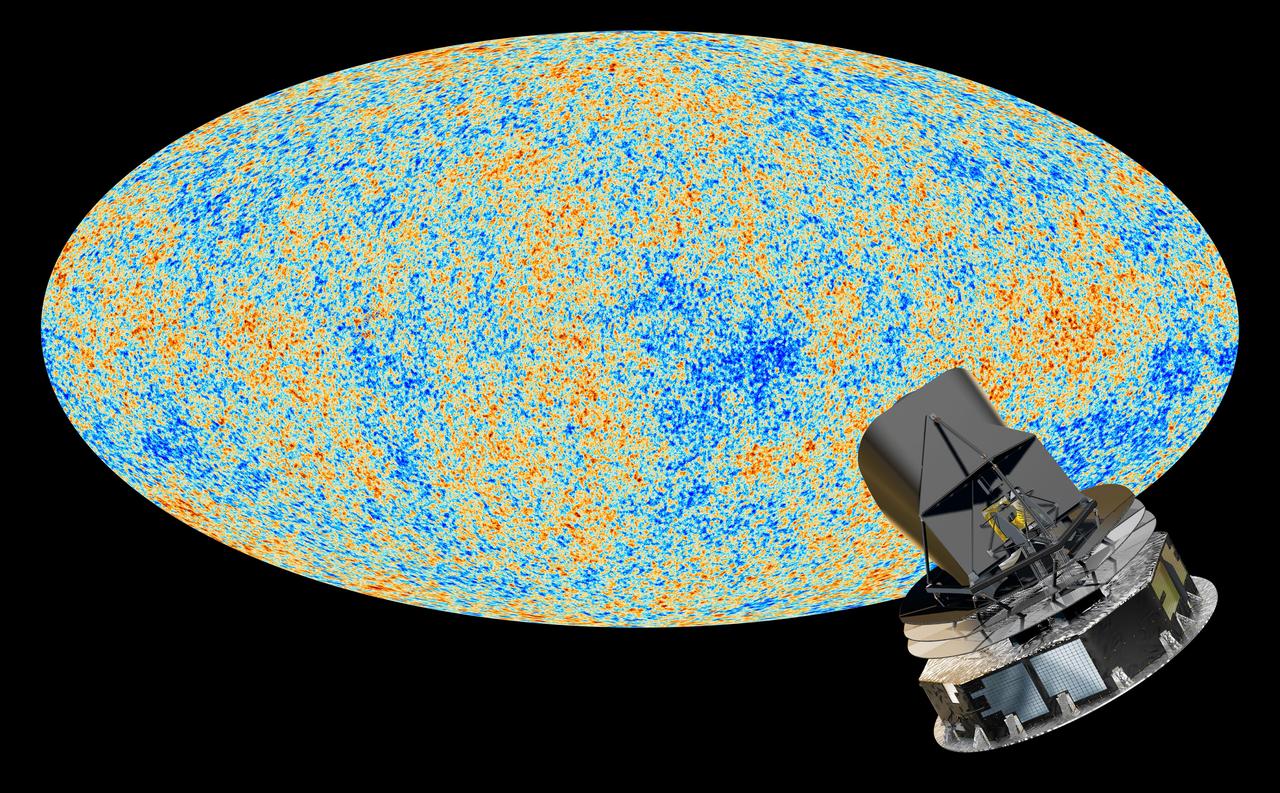
Look at the sky in microwaves and you see an almost perfectly uniform glow, about 2.7 kelvin above absolute zero. It comes from everywhere, equally, in every direction. For a while this was an embarrassment — how could the entire cosmos agree on a temperature with no way to communicate? Then the answer became clear: at earlier times the universe was far hotter and denser, and the radiation we see was released when that hot, opaque plasma cooled enough to become transparent.
That moment is called recombination. Before it, electrons and protons formed a dense fog that scattered light constantly. As the universe expanded and cooled, protons and electrons combined into neutral atoms, opacity plummeted, and photons were suddenly free to travel essentially forever. They started their journey when the universe was roughly one-thousandth of its present size, about 380,000 years after the beginning, and their wavelengths have been stretched by a factor of about a thousand since then.1
What the mottled picture shows
The famous all-sky maps do not show a uniform glow. They show temperature differences of a few tens of microkelvin across the sky — a pattern of warmer and cooler patches. Those patches are the imprint of density variations: slightly denser regions were deeper gravitational wells and hosted different acoustic conditions than slightly emptier ones. The characteristic angular size of those patches traces the sound waves that ran through the early plasma.
Measuring the pattern precisely is cosmology's most powerful observational tool. The scale of the bumps tells us about the geometry of space; their amplitude tells us about the mix of ordinary matter, radiation, and dark matter. The results, from COBE to WMAP to Planck, converged on a picture that is now standard.2,3
The standard accounting (modern best fit)
Roughly: about 68% dark energy, about 27% dark matter, about 5% ordinary matter. These proportions come from fitting observational data, and the uncertainty band on each is now small. What dark matter and dark energy are is a separate and much less settled question.
What it fixed, and what it did not
The background radiation settled several long-standing arguments. It provided a natural explanation for the uniformity of the universe, converted the Big Bang from a contested idea into a framework with a dated event, and it made the baryon-to-photon ratio measurable. It also has a few features that nobody anticipated: the power spectrum shows a small quadrupole deficit at very large scales, and the anisotropies include a handful of anomalies whose interpretation remains debated.
- confirmed The cosmic microwave background is relic radiation from an early, hot, dense state, with residual temperature about 2.725 K.
- confirmed Its acoustic peaks provide tight constraints on many cosmological parameters.
- open The nature of dark matter and dark energy is unknown.
- speculative Attempts to explain large-angle anomalies with pre-Big-Bang structures or unusual topologies are hypotheses, not settled results.
Why it is still worth looking
Future measurements target the polarisation of the radiation, and in particular a faint signature called B-mode polarisation that could be left by gravitational waves from the very early universe. If it exists, it would be our clearest window onto the physics of the beginning. Detecting it is difficult and has produced at least one retracted or heavily qualified claim, which is a reminder of how much care is needed at that sensitivity. The honest status is: the instrument is credible, the search is active, the answer is not yet in.
Further reading (external sources)
- NASA, Cosmic Background Explorer (COBE) and the cosmic microwave background — lambda.gsfc.nasa.gov.
- Planck Collaboration, “Planck 2018 results VI: Cosmological parameters”, Astronomy & Astrophysics 641, A6 (2020) — doi:10.1051/0004-6361/201833910.
- Nobel Prize in Physics 2006, “for discoveries of the blackbody form and anisotropy of the cosmic microwave background” — nobelprize.org.
This article is an original explanatory text written for The Open System; it is not a translation or a reproduction of any source above. Sources are listed for verification and further reading. Image: NASA (public domain).